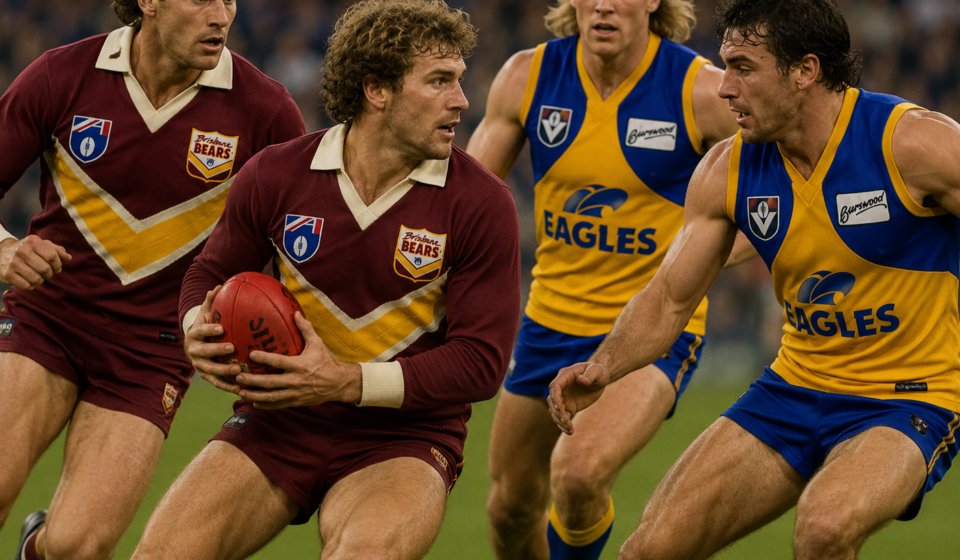

Nearly four decades on, the Brisbane and West Coast football clubs have formally requested the return of their original $4 million entry fees, along with what one leaked internal memo describes as “reasonable interest, emotional damages, and forty years of being treated like a rounding error.”
The joint claim, submitted to league headquarters this week, alleges that in exchange for the fee, both clubs were promised “full and equal status” within the competition — a phrase since quietly retired from all league literature.
“We were told we were pioneers,” said a spokesperson for the claim, flanked by a folder marked 1986 — DO NOT ARCHIVE. “Turns out ‘pioneer’ was code for ‘gets the bye during Grand Final week’ and ‘plays home games at 4:40pm on a Sunday in front of a dog and a light plane.”
Documents obtained as part of the claim — believed to be genuine, though the league has neither confirmed nor denied their existence, nor entirely denied setting fire to a filing cabinet in 1993 — reportedly include a draft concession schedule so lopsided that one clause simply reads: “Zones: Victorian clubs, all of them. Other clubs: good luck.”
The claim further alleges that the competition rebranded from the Victorian Football League to the Australian Football League in 1990 specifically so that Brisbane and West Coast’s presence could be retroactively described as the founding vision of a “national competition,” rather than what several historians have called “a financial necessity dressed up as an act of generosity.”
“They didn’t expand the competition for us,” the spokesperson said. “They expanded it at us. There’s a difference.”
A league statement in response, evidently written by Gerard Whateley, described the claim as “a nostalgic misreading of a complex administrative period,” adding that “any perceived inequality in the 1980s and 90s has since been more than balanced out by the introduction of music after goals.”
The statement did not address the $8 million.
Long-time Eagles member Trevor Faraway, who was present for the club’s first ever match, says he isn’t surprised the money was never accounted for. “We were told we were buying a seat at the table. Turned out we bought a chair, and the table was in Melbourne, and we weren’t invited to sit at it for another twenty years.”
“Those first couple of years, they made the Bears train on a swamp with only an abandoned school bus as changerooms,” laments Alice Weakbeer from Coolangatta.
The league has since pointed to the more recent additions of Gold Coast and Greater Western Sydney as evidence that “the expansion model has been significantly refined,” noting both clubs were given priority draft picks, salary cap concessions, and — in a detail the original claimants have specifically flagged in their submission — “considerably more than a firm handshake and a fixture full of away games.”
“Funny that,” the spokesperson said. “Almost like someone in a boardroom eventually read our file and thought, ‘yeah, fair enough, let’s not do that again.’ Bit late for us. But glad they got the memo. Eventually. After forty years. And $8 million.”
At time of publication, the league had offered to settle the matter with a commemorative guernsey and an invitation to a “Heritage Round” lunch, catering not included.
It’s believed that Brisbane’s main argument centres around the fact that it was forced to merge to survive. “The AFL hated us so much, they made us merge with Fitzroy,” the spokesperson said.
Representatives from the Melbourne, St Kilda and Richmond football clubs were contacted for comment on how they used the money they received from these fees, but none wished to speak.